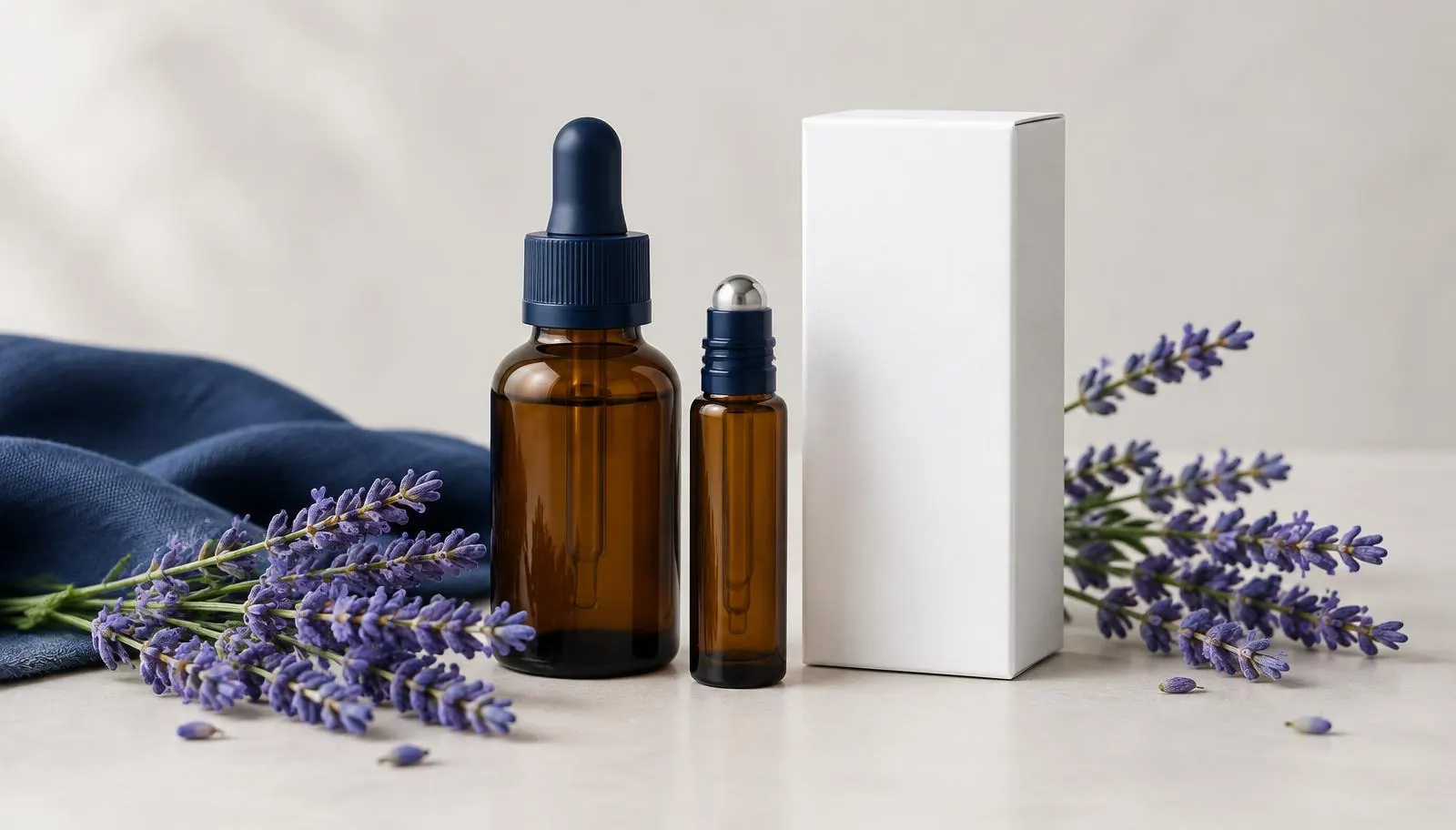
Short answer: Yes. Most essential oil and aromatherapy kits can be private labeled and sold on Amazon, but three things decide how smooth it is: your claims (FDA treats "helps you sleep" as a drug claim), each oil's Safety Data Sheet (Amazon reviews essential oils as possible dangerous goods), and packaging (liquids with more than 5% methyl salicylate need child-resistant caps).
A private label aromatherapy kit is a set of scent products (essential oils, diffuser blends, roller balls, bath salts) made by a contract manufacturer and sold under your brand. Which rules apply to it depends mostly on what you say it does.
Key numbers: aromatherapy kits on Amazon
- 5%: methyl salicylate by weight above which liquids need child-resistant packaging [6]
- 10% / 100 SUS: hydrocarbon content and viscosity that bring some liquid cosmetics under child-resistant rules [6]
- 60 °C (140 °F): flash point at or below which a liquid is a flammable liquid for U.S. transport [4]
- 100 °F and 150 °F: the upper limits for "flammable" and "combustible" liquids under the Federal Hazardous Substances Act [5]
- 15 business days: deadline to report a serious cosmetic adverse event to FDA under MoCRA [8]
- 2 years: how often cosmetic facility registrations must be renewed [8]
Is an aromatherapy product a cosmetic, a drug or a consumer product?
Calling a product "aromatherapy" doesn't decide how it's regulated. FDA says the category comes from the product's intended use: "If a product is intended only to cleanse the body or to make a person more attractive, it's a cosmetic," while a product intended "to affect the structure or function of the body" is a drug [1]. FDA lists claims that a product will "relieve colic, ease pain, relax muscles, treat depression or anxiety, or help you sleep" as drug claims [1].
Intended use is not only what's printed on the bottle. FDA also looks at claims in advertising and on the internet, consumer perception, and ingredients with a well-known therapeutic use [2]. For an Amazon brand, that includes the listing title, bullets, A+ content and images. FDA also notes that some fragrance products, such as air fresheners and scented candles, are regulated by the Consumer Product Safety Commission (CPSC) [1].
| Product and claim | Likely category | Source |
|---|---|---|
| Perfume oil “to smell good” | Cosmetic | FDA [1] |
| Massage oil “to lubricate the skin and impart fragrance” | Cosmetic | FDA [2] |
| Massage oil “relieves muscle pain” | Drug | FDA [2] |
| Scent “helps you sleep” or “helps you quit smoking” | Drug | FDA [1][2] |
| Lotion that moisturizes and “relieves colic” | Cosmetic and drug | FDA [1] |
| Scented candle or air freshener | Consumer product (CPSC) | FDA [1] |
A kit can mix categories. A roller ball sits in FDA territory, while a candle in the same box is a CPSC product. Plan each item on its own.
Why do essential oils get flagged for Amazon hazmat review?
Amazon lists essential oils, along with perfume sprays and nail polish, as examples of everyday products that can be dangerous goods ("hazmat"), meaning they "could pose a risk if not stored, shipped, or handled properly" [3]. Sellers upload either a Safety Data Sheet (SDS) or an exemption sheet for review [3].
The number that usually decides the outcome is the flash point. Under U.S. transport rules, a liquid with a flash point of not more than 60 °C (140 °F) is a flammable liquid [4]. Under the Federal Hazardous Substances Act, a liquid is "flammable" if its flash point is above 20 °F and below 100 °F, and "combustible" from 100 °F up to 150 °F [5]. Each oil's SDS states its flash point, so ask your manufacturer for an SDS per oil and per blend before you create listings.

When do essential oils need child-resistant packaging?
Under the Poison Prevention Packaging Act rules, "liquid preparations containing more than 5 percent by weight of methyl salicylate" (other than pressurized sprays) must be in child-resistant packaging [6]. Wintergreen oil contains methyl salicylate. In December 2025, CPSC warned consumers to stop using a wintergreen essential oil sold on Amazon.com from May 2022 through August 2025 because it was not in child-resistant packaging [7].
A second rule covers some thin, oily liquids: non-emulsion liquid drugs or cosmetics with 10% or more hydrocarbons by weight and a viscosity under 100 SUS at 100 °F need child-resistant packaging too, with listed exemptions [6]. Ask your manufacturer to check every blend against both rules before you choose caps and droppers.
What does each label need?
For items sold as cosmetics, FDA's labeling guide lists, among other things: an identity statement, net quantity of contents, the name and place of business of the manufacturer, packer or distributor, an ingredient declaration in descending order of predominance, and any warning statements needed to prevent a health hazard [9]. A kit has two levels, the outer box and each bottle, so decide early which information goes where.
Under the Modernization of Cosmetics Regulation Act (MoCRA), the "responsible person" is the manufacturer, packer or distributor whose name appears on the label. That person must list each marketed cosmetic product with FDA, report serious adverse events within 15 business days and keep safety substantiation records. Manufacturers and processors must register their facilities and renew every two years [8]. If your brand is the name on the label, those listing duties are yours, so agree in writing who prepares the filings.
The Five-Gate Amazon Launch Path
Use these five gates in order. Each one is cheaper to fix before the next.
- 1.Claims gate: Write the label, listing title and bullets first, and check them against FDA's cosmetic and drug examples [1][2].
- 2.SDS gate: Collect an SDS for every oil and blend, and note each flash point against the 60 °C transport line [4].
- 3.Packaging gate: Check each blend for methyl salicylate above 5% and the hydrocarbon rule. Choose child-resistant closures where required [6].
- 4.Label and filing gate: Finish cosmetic labels for the box and each item [9], and assign MoCRA product listing to the responsible person [8].
- 5.Prep gate: Plan FBA prep for the kit: unit labels, bundling, polybagging and case packing. Amazon rejects inbound shipments that don't meet its prep and labeling rules [10].
Aromatherapy Kit Amazon-Ready Checklist
Download the fillable checklist (PDF)
Use this list before you create listings or request quotes:
Claims and category
SDS and hazmat review
Packaging
What are the minimums and timeline at PMG?
PMG manufactures essential oils, diffuser blends, roller balls, bath salts, massage oils, candles, reed diffusers and room sprays, and sources essential oils with traceability documentation and GC/MS testing for purity and identity [11]. PMG's minimum order starts at 1,000 units on private label stock formulas and 5,000 units for custom formulations [12]. Private label puts finished product on the shelf in 60–90 days [13]. For a kit, confirm how the minimum applies to each item inside it.
On the Amazon side, PMG's fulfillment team handles FBA prep (FNSKU labeling, polybagging, suffocation warnings, bundling and case packing), kitting and FBM order processing [10]. See our wellness and aromatherapy page, our fulfillment and 3PL page, private label vs custom formulation and our guide to MOQ and manufacturing volume.
Glossary
- SDS (Safety Data Sheet): a standardized document listing a material's hazards and properties, including flash point.
- Flash point: the lowest temperature at which a liquid gives off enough vapor to ignite.
- Dangerous goods (hazmat): Amazon's term for products that could pose a risk if not stored, shipped or handled properly. [3]
- Exemption sheet: a document a seller can upload to Amazon instead of an SDS for review. [3]
- PPPA: the Poison Prevention Packaging Act, under which CPSC sets child-resistant packaging rules.
- MoCRA: the Modernization of Cosmetics Regulation Act of 2022.
- Responsible person: under MoCRA, the manufacturer, packer or distributor whose name appears on the label. [8]
- FNSKU: Amazon's fulfillment barcode for an FBA unit.
- FBM: fulfilled by merchant; the seller (or its 3PL) ships Amazon orders.
Frequently asked questions
Can I call my blend “relaxing” or “for sleep”?
FDA lists “help you sleep,” “relax muscles” and “treat depression or anxiety” as drug claims. Words that describe the scent itself carry less risk than words about what it does to the body. Have every claim reviewed before you print labels or publish the listing. [1]
Will Amazon accept essential oils through FBA?
Amazon reviews essential oils as possible dangerous goods, and you upload an SDS or exemption sheet for each listing. The result depends on the review. Have each SDS ready before you create the listing, and plan for seller-fulfilled shipping (FBM) if a product can't go through FBA. [3]
Do candles in the kit follow the same rules?
No. FDA lists scented candles and air fresheners among the fragrance products regulated by CPSC. Treat each item in a mixed kit on its own. [1]
Who registers with FDA under MoCRA, me or the manufacturer?
Manufacturers and processors register their facilities. The responsible person (the name on the label) lists each product and reports serious adverse events. Agree in writing who prepares each filing. [8]
What is the minimum order for a private label aromatherapy line at PMG?
PMG's minimum starts at 1,000 units on private label stock formulas and 5,000 units for custom formulations, and private label typically takes 60–90 days to reach the shelf. Request a consultation to confirm how it applies to the items in your kit. [12][13]
Can You Make Sugar-Free Pectin Gummies with Allulose?
How the gel changes without sugar, allulose vs sugar alcohols vs monk fruit and stevia, what a sugar-free label needs, and realistic minimums.
Read the article →How to Choose a Private Label Manufacturing Partner
10 questions to ask before you sign, plus a free evaluation checklist.
Read the article →MOQ and Manufacturing Volume: What Actually Matters
Why minimums exist, what they cost below volume, and how to plan a first run you can sell through.
Read the article →How Much Does It Cost to Manufacture Supplements?
A phase-by-phase breakdown of R&D, ingredients, production, packaging, and compliance costs.
Read the article →What Does It Take to Manufacture an OTC Acne Product?
Allowed actives and strengths, Drug Facts labeling, NDCs and registration, and realistic OTC minimums and timelines.
Read the article →Sources and references
- 1.FDA, “Aromatherapy” (updated Sep 8, 2023) https://www.fda.gov/cosmetics/cosmetic-products/aromatherapy
- 2.FDA, “Is It a Cosmetic, a Drug, or Both? (Or Is It Soap?)” (updated Sep 11, 2024) https://www.fda.gov/cosmetics/cosmetics-laws-regulations/it-cosmetic-drug-or-both-or-it-soap
- 3.Amazon, “What Amazon FBA sellers should know about dangerous goods (hazmat)” (Jan 4, 2025) https://sell.amazon.com/blog/amazon-hazmat-dangerous-goods
- 4.49 CFR 173.120, Class 3 flammable and combustible liquids https://www.ecfr.gov/current/title-49/subtitle-B/chapter-I/subchapter-C/part-173/subpart-D/section-173.120
- 5.16 CFR 1500.3(c)(6), FHSA flammability definitions https://www.ecfr.gov/current/title-16/chapter-II/subchapter-C/part-1500/section-1500.3
- 6.16 CFR 1700.14(a)(3) and (a)(32), substances requiring special packaging https://www.ecfr.gov/current/title-16/chapter-II/subchapter-E/part-1700/section-1700.14
- 7.CPSC warning on a wintergreen essential oil sold on Amazon (Dec 11, 2025) https://cpsc.gov/Warnings/2026/CPSC-Warns-Consumers-to-Immediately-Stop-Using-HiQiLi-Wintergreen-Essential-Oil-Due-to-Risk-of-Serious-Injury-or-Death-from-Poisoning-to-Young-Children-Violates-Mandatory-Standard-for-Child-Resistant-Packaging
- 8.FDA, “Modernization of Cosmetics Regulation Act of 2022 (MoCRA)” (updated Aug 10, 2026) https://www.fda.gov/cosmetics/cosmetics-laws-regulations/modernization-cosmetics-regulation-act-2022-mocra
- 9.FDA, “Cosmetics Labeling Guide” https://www.fda.gov/cosmetics/cosmetics-labeling-regulations/cosmetics-labeling-guide
- 10.PMG, “Fulfillment & 3PL” https://productmgmtgroup.com/services/fulfillment-3pl
- 11.PMG, “Wellness & Aromatherapy” https://productmgmtgroup.com/industries/wellness-and-aromatherapy
- 12.PMG homepage, “Built for startups, scaled for retail” https://productmgmtgroup.com/
- 13.PMG, “Private Label vs Custom Formulation” https://productmgmtgroup.com/services/private-label-vs-custom-formulation
Aromatherapy Kit Amazon-Ready Checklist
A fillable 1-page checklist to complete before you create listings or request quotes.
PDF · 1 page
About Product Management Group
PMG is a full-service private label manufacturing partner for skincare, nutraceuticals, supplements, personal care, and wellness brands. We handle everything from R&D and formulation through manufacturing, packaging, regulatory compliance, and fulfillment, working with FDA-registered, GMP-compliant partner facilities in Florida, North Carolina, Texas, Minnesota, and Arizona. We work with everyone from first-time founders to established retail brands, with minimums starting at 1,000 units.
Planning an aromatherapy kit for Amazon? Request a consultation and tell us the items in your kit, your claims and your target units.